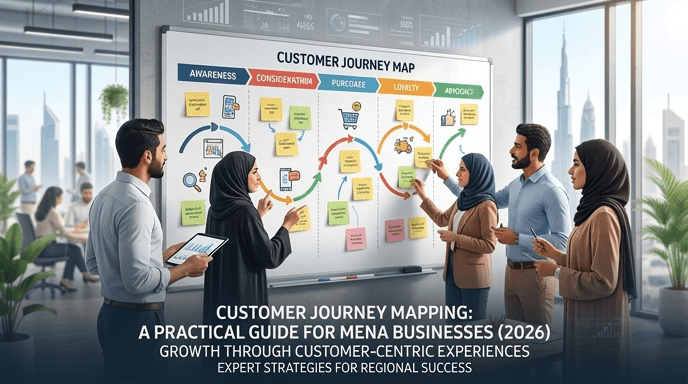
Customer journey mapping is the process of visualising every interaction a customer has with your business — from first awareness through purchase and beyond. For MENA businesses, effective journey mapping must account for bilingual touchpoints (Arabic and English), WhatsApp-first communication preferences, region-specific payment gateways, and cultural nuances that influence buying decisions across UAE, Saudi Arabia, and Lebanon. Companies that map and optimise their customer journeys see 54% greater return on marketing investment and 56% more cross-sell and up-sell revenue.
What Is Customer Journey Mapping?
A customer journey map is a visual representation of every step a customer takes when interacting with your brand. It documents the touchpoints, emotions, pain points, and decision triggers across the entire buying process — from the moment someone becomes aware of your business to post-purchase loyalty.
Unlike a simple sales funnel, a journey map captures the customer's perspective. It answers: What is the customer thinking, feeling, and doing at each stage? Where do they get stuck? What makes them convert — or abandon?
- 54% greater return on marketing investment for companies with journey maps (Aberdeen Group, 2025)
- 56% more cross-sell and up-sell revenue from mapped journeys (Salesforce State of Marketing, 2025)
- 10x improvement in customer onboarding speed with mapped journeys (McKinsey, 2025)
- 73% of MENA consumers expect personalised experiences across channels (PwC Middle East, 2025)
The 5 Stages of the Customer Journey in MENA
While the classic marketing funnel applies globally, MENA markets have unique characteristics at each stage that businesses must account for:
Stage 1: Awareness
In MENA, awareness often starts on social media — particularly Instagram, TikTok, and Snapchat in KSA and UAE. Google search follows, but WhatsApp referrals and word-of-mouth play an outsized role compared to Western markets. According to Hootsuite's 2025 Digital Report, UAE has a 98.99% social media penetration rate, the highest globally.
Stage 2: Consideration
MENA buyers heavily research before purchasing. They check Google reviews, ask in WhatsApp groups, and compare options across Arabic and English content. Bilingual content is non-negotiable — 67% of Saudi consumers prefer browsing in Arabic but switch to English for technical details (Google MENA Consumer Insights, 2025).
Stage 3: Decision
Trust signals matter more in MENA than in Western markets. Buyers look for local office presence, Arabic customer support, region-specific certifications, and payment options including Tabby, Tamara (buy-now-pay-later), and local bank transfers alongside credit cards.
Stage 4: Purchase
Cash on delivery still accounts for 40% of e-commerce transactions in Saudi Arabia (Checkout.com MENA Payments Report, 2025). Journey maps for MENA must account for COD logistics, BNPL integration, and the WhatsApp order confirmation flow that many customers expect.
Stage 5: Retention & Advocacy
Post-purchase, MENA customers expect WhatsApp follow-ups over email. Loyalty programs tied to mobile wallets (Apple Pay, STC Pay in KSA) see 3x higher engagement than traditional point systems. Referral incentives work exceptionally well — MENA's collectivist culture makes personal recommendations the strongest conversion driver.
How to Create a Customer Journey Map: Step-by-Step
Step 1: Define Your Customer Personas
Start with 2-3 personas based on actual customer data. For MENA businesses, segment by language preference (Arabic-first vs English-first), platform behaviour (Instagram-first vs Google-first), and purchase driver (price-sensitive vs quality-focused). Use your CRM data, Google Analytics audience reports, and sales team interviews.
Step 2: List Every Touchpoint
Document every interaction point across the journey. Common MENA touchpoints include:
- Discovery: Google Search, Instagram Reels, TikTok, WhatsApp forwards, Snapchat (KSA)
- Research: Website (Arabic + English), Google Business Profile, YouTube reviews
- Engagement: WhatsApp chat, Instagram DMs, phone calls, live chat
- Purchase: Website checkout, WhatsApp ordering, in-store (if applicable)
- Post-purchase: WhatsApp updates, email sequences, loyalty app, Google review request
Step 3: Map Emotions and Pain Points
At each touchpoint, document what the customer is feeling. Common MENA-specific pain points include: Arabic website pages that feel like afterthought translations, checkout pages without local payment options, customer support only available in English, and shipping estimates that are vague or inaccurate.
Step 4: Identify Drop-Off Points
Use Google Analytics 4 funnel exploration reports and heatmap tools like Microsoft Clarity (free) to find where customers abandon the journey. In MENA, the most common drop-off points are:
- Checkout page (no COD or BNPL option) — 35% abandonment
- Lead form (too many fields, no WhatsApp option) — 60% abandonment
- Arabic pages with poor UX — 45% higher bounce rate than English equivalents
Step 5: Design the Optimised Journey
For each pain point, design a specific fix. Prioritise changes by impact (revenue affected) and effort (implementation time). Quick wins for MENA businesses often include: adding WhatsApp as a contact option (+40% lead capture), adding Tabby/Tamara BNPL (+25% checkout completion), and improving Arabic page quality (+30% engagement).
"The biggest mistake MENA businesses make is copying Western journey maps without adapting for local behaviour. WhatsApp isn't just a messaging app here — it's the primary commerce channel for many segments."
Customer Journey Mapping Tools for MENA Teams
| Tool | Best For | Price | Arabic Support |
|---|---|---|---|
| Miro | Visual journey mapping workshops | Free-$16/mo | RTL boards supported |
| Lucidchart | Detailed process flows | Free-$9/mo | Limited RTL |
| HubSpot | Journey automation + CRM integration | Free-$800/mo | Full Arabic UI |
| Microsoft Clarity | Free heatmaps + session recordings | Free | Full Arabic support |
| Google Analytics 4 | Funnel analysis + path exploration | Free | Full Arabic UI |
AI-Powered Journey Personalisation
AI is transforming customer journey mapping from a static exercise into a dynamic, real-time system. Modern AI tools can:
- Predict drop-offs before they happen using behavioural signals
- Personalise content based on language preference, location, and browsing history
- Automate WhatsApp sequences triggered by specific journey milestones
- Score leads in real-time to prioritise sales team outreach
At Hovi Digital Lab, we build AI-powered journey systems that automatically adapt touchpoints based on customer behaviour — delivering the right message, in the right language, on the right channel, at the right moment.
Frequently Asked Questions
What is customer journey mapping?
Customer journey mapping is the process of creating a visual representation of every interaction a customer has with your business, from first awareness to post-purchase loyalty. It helps identify pain points, optimise touchpoints, and improve the overall customer experience.
How long does it take to create a customer journey map?
A basic journey map can be created in 1-2 weeks with stakeholder interviews and analytics review. A comprehensive, data-driven map with persona research and customer interviews typically takes 4-6 weeks.
What makes customer journey mapping different in MENA?
MENA journey maps must account for bilingual touchpoints (Arabic + English), WhatsApp-first communication, region-specific payment methods (COD, Tabby, Tamara), and cultural factors like the importance of personal relationships and word-of-mouth referrals.
How often should you update a customer journey map?
Review and update your journey map quarterly, or whenever you launch a new product, enter a new market, or see significant changes in customer behaviour data. AI-powered journey systems can update in real-time based on behavioural signals.