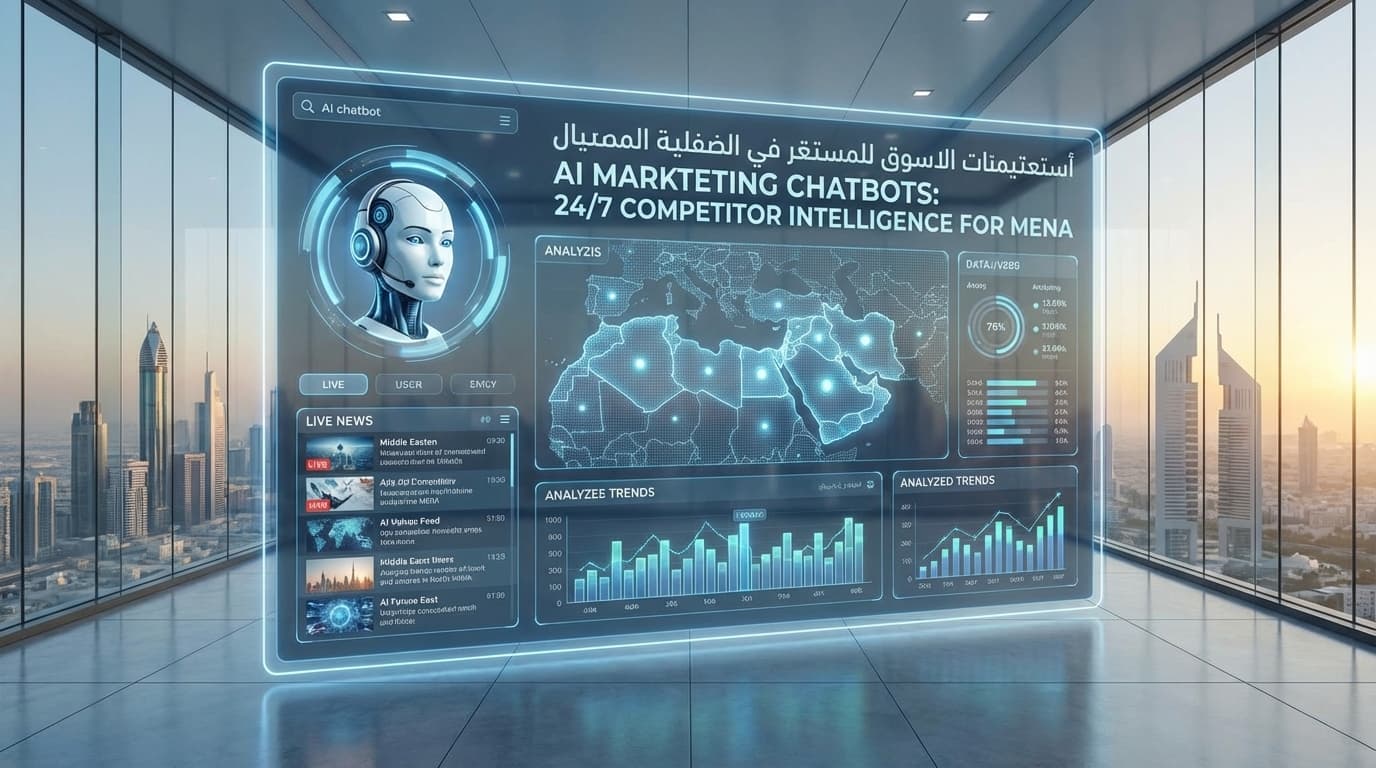
An AI marketing chatbot is an intelligent conversational agent that uses natural language processing and real-time data analysis to engage website visitors, qualify leads, answer product questions, and monitor competitor activity around the clock. Unlike basic rule-based chatbots, AI marketing chatbots learn from every interaction, adapt their responses based on visitor behaviour, and deliver competitor intelligence reports that inform strategic marketing decisions across MENA markets.
What Is an AI Marketing Chatbot?
An AI marketing chatbot goes far beyond the simple FAQ bots that dominated the 2020s. Modern AI marketing chatbots are powered by large language models, trained on your brand's knowledge base, product catalogue, and competitive landscape. They understand context, handle multi-turn conversations, and make real-time decisions about whether a visitor needs product information, should be routed to sales, or is a competitor conducting research.
According to Gartner (2024), by 2027, chatbots will become the primary customer service channel for 25% of organisations worldwide. But the marketing applications extend well beyond customer service. AI chatbots now function as always-on marketing team members: qualifying leads at 3 AM, capturing competitive intelligence from visitor conversations, and personalising the website experience based on who is browsing.
According to Drift (2024), chatbots save businesses an average of $300,000 per year in customer service costs alone. When you add the marketing value — lead qualification, competitive intelligence, and conversion optimisation — the ROI multiplies significantly.
5 Use Cases for AI Marketing Chatbots
- Instant Lead Qualification. When a visitor lands on your site, the AI chatbot can determine within 2-3 questions whether they are a qualified prospect, a researcher, or a competitor. Qualified leads are fast-tracked to the sales team with full context — what pages they visited, what questions they asked, and what their likely budget and timeline are. According to Salesforce (2024), 69% of consumers prefer chatbots for quick communication with brands, making chatbots the path of least resistance for lead capture.
- 24/7 Competitor Monitoring. This is where AI chatbots deliver unique marketing intelligence. By analysing conversations, the chatbot identifies when competitors' customers visit your site ("I currently use [Competitor X]"), what features they are comparing, and which pain points drive them to explore alternatives. Over time, the chatbot builds a competitive intelligence database that reveals market positioning gaps, pricing sensitivities, and feature requests you might not discover through any other channel. Hovi's AI Marketing Chatbot generates weekly competitor intelligence reports directly from these conversation patterns.
- Personalised Product Recommendations. For businesses with multiple products or services, the AI chatbot acts as a guided selling tool. Instead of forcing visitors to navigate complex product pages, the chatbot asks about their goals, budget, and challenges, then recommends the most relevant solution. This conversational commerce approach increases conversion rates by 15-30% compared to self-service navigation — because the chatbot eliminates choice paralysis and friction simultaneously.
- Automated Appointment Booking. For service businesses, clinics, agencies, and consultancies across MENA, the chatbot handles the entire booking process: checking calendar availability, confirming time zones (critical in a region spanning GMT+3 to GMT+4), sending confirmations, and triggering pre-meeting preparation sequences. According to HubSpot (2024), 47% of consumers would complete a purchase through a chatbot interaction, including booking appointments and scheduling consultations.
- Content Distribution and Engagement. AI chatbots proactively surface relevant content based on visitor behaviour. A visitor reading a blog post about AI paid advertising might receive a chatbot suggestion to download a related case study or watch a video tutorial. This intelligent content distribution keeps visitors engaged longer and moves them deeper into the marketing funnel — all without manual intervention.
AI Chatbots vs Traditional Live Chat
| Capability | Traditional Live Chat | AI Marketing Chatbot | Business Impact |
|---|---|---|---|
| Availability | Business hours only (8-10 hrs/day) | 24/7/365, no breaks or holidays | 3x more conversations captured |
| Response Time | 2-5 minutes average wait | Under 2 seconds | 80% reduction in visitor drop-off |
| Simultaneous Conversations | 3-5 per agent | Unlimited | No queuing during traffic spikes |
| Lead Qualification | Manual, inconsistent across agents | Consistent scoring based on trained criteria | 40% higher SQL quality |
| Competitor Intelligence | Rarely captured or systematised | Automatically logged and reported weekly | Unique strategic data source |
| Language Support | Limited to agent skills | Arabic, English, French simultaneously | Full GCC market coverage |
| Cost Per Conversation | $5-15 per interaction | $0.10-0.50 per interaction | 90%+ cost reduction |
| Learning | Depends on agent training programmes | Improves with every conversation automatically | Compounding performance gains |
How AI Chatbots Track Competitors 24/7
Competitive intelligence is one of the most undervalued applications of AI chatbots. Here is how it works in practice:
Every conversation with your chatbot generates data. When a visitor says "I am currently using [Competitor X] and looking for alternatives," the AI logs the competitor name, the context, and the reason for switching. When a visitor asks "Do you offer [Feature Y]?" and that feature is something your competitor promotes but you do not, the chatbot flags this as a competitive gap.
Over weeks and months, these individual data points aggregate into strategic intelligence:
- Win/loss patterns: Which competitors are you winning against, and why? Which are you losing to, and what do their customers value?
- Feature comparison requests: Which features do prospects compare most frequently? This reveals the decision criteria that matter most in your market.
- Pricing sensitivity: How often do visitors mention price as a factor? What price ranges are they comparing? This informs pricing strategy directly.
- Market shifts: When a competitor launches a new product or changes pricing, their customers often start researching alternatives. The chatbot detects these waves before they show up in any other data source.
Hovi's AI Marketing Chatbot compiles this intelligence into weekly reports that marketing and sales teams can act on — adjusting messaging, updating comparison pages, and proactively reaching out to prospects showing competitive intent.
Implementing AI Chatbots for MENA Markets
The MENA region presents unique considerations for AI chatbot implementation:
Arabic Language Processing
Modern AI chatbots handle Modern Standard Arabic effectively, but the real challenge is dialectal variation. A customer in Saudi Arabia speaks differently from one in Lebanon or Egypt. The best AI chatbots for MENA markets are configured to understand Gulf Arabic, Levantine Arabic, and Egyptian Arabic — responding in the dialect the visitor uses, or defaulting to Modern Standard Arabic for formal interactions. Bilingual capability (Arabic and English in the same conversation) is essential, as many GCC residents code-switch naturally.
Cultural Conversation Norms
MENA customers expect a more personal conversational style than Western markets. AI chatbots should be configured with appropriate greetings, acknowledgements, and relationship-building language before transitioning to business topics. A chatbot that launches immediately into lead qualification without a warm opening will feel jarring to Gulf audiences.
Integration with Regional Platforms
Beyond website deployment, AI chatbots in MENA should integrate with WhatsApp Business (the dominant messaging platform across the region), Instagram DM (critical for B2C brands), and potentially Snapchat for younger audiences in Saudi Arabia and UAE.
Ramadan and Seasonal Adaptation
AI chatbots should be configured to adjust tone, timing, and offers during Ramadan, Eid periods, and other regional events. This includes modified operating hours for live agent escalation and culturally appropriate messaging.
Frequently Asked Questions
How much does an AI marketing chatbot cost to implement?
Implementation costs for an AI marketing chatbot range from $2,000-15,000 for initial setup and training, with monthly operational costs of $500-3,000 depending on conversation volume and complexity. For context, a single full-time live chat agent costs $3,000-5,000 per month in the GCC and covers only business hours. An AI chatbot handles unlimited conversations 24/7 at a fraction of the cost — typically achieving positive ROI within the first 60 days through lead capture alone.
Can an AI chatbot really understand Arabic conversations?
Yes. Modern large language models handle Arabic well, including dialectal variations common across the GCC. The key is proper training: the chatbot must be configured with your brand's Arabic content, product terminology in Arabic, and examples of how your customers typically express their needs. For mission-critical conversations (high-value leads, complex technical questions), the chatbot should be configured to seamlessly escalate to human agents when confidence drops below a threshold.
How is an AI marketing chatbot different from a customer support chatbot?
A customer support chatbot answers questions from existing customers about orders, returns, and account issues. An AI marketing chatbot engages prospective customers and converts them into leads. The key differences are intent detection (marketing chatbots identify purchase signals), lead scoring (they qualify prospects in real-time), competitor intelligence (they log competitive mentions), and proactive engagement (they initiate conversations based on visitor behaviour rather than waiting for questions). Some businesses deploy both, using different configurations optimised for each purpose.
What kind of competitor intelligence can an AI chatbot actually provide?
An AI chatbot provides three categories of competitive intelligence: switching signals (which competitors' customers are exploring alternatives and why), feature comparison data (which capabilities are most frequently compared), and pricing intelligence (what price points and packaging models prospects are evaluating). Over 3-6 months, this data reveals patterns that traditional competitive analysis misses — because it comes from actual buying behaviour rather than desk research. The most actionable insights are often about what competitors do not offer that prospects wish they did.
Ready to deploy an AI chatbot that qualifies leads and monitors competitors around the clock? Book a strategy session with Hovi Digital Lab. We will assess your current visitor engagement, identify the highest-value chatbot use cases for your business, and build a custom AI chatbot trained on your brand's knowledge base. Explore our AI Marketing Chatbot product to see the full capabilities.