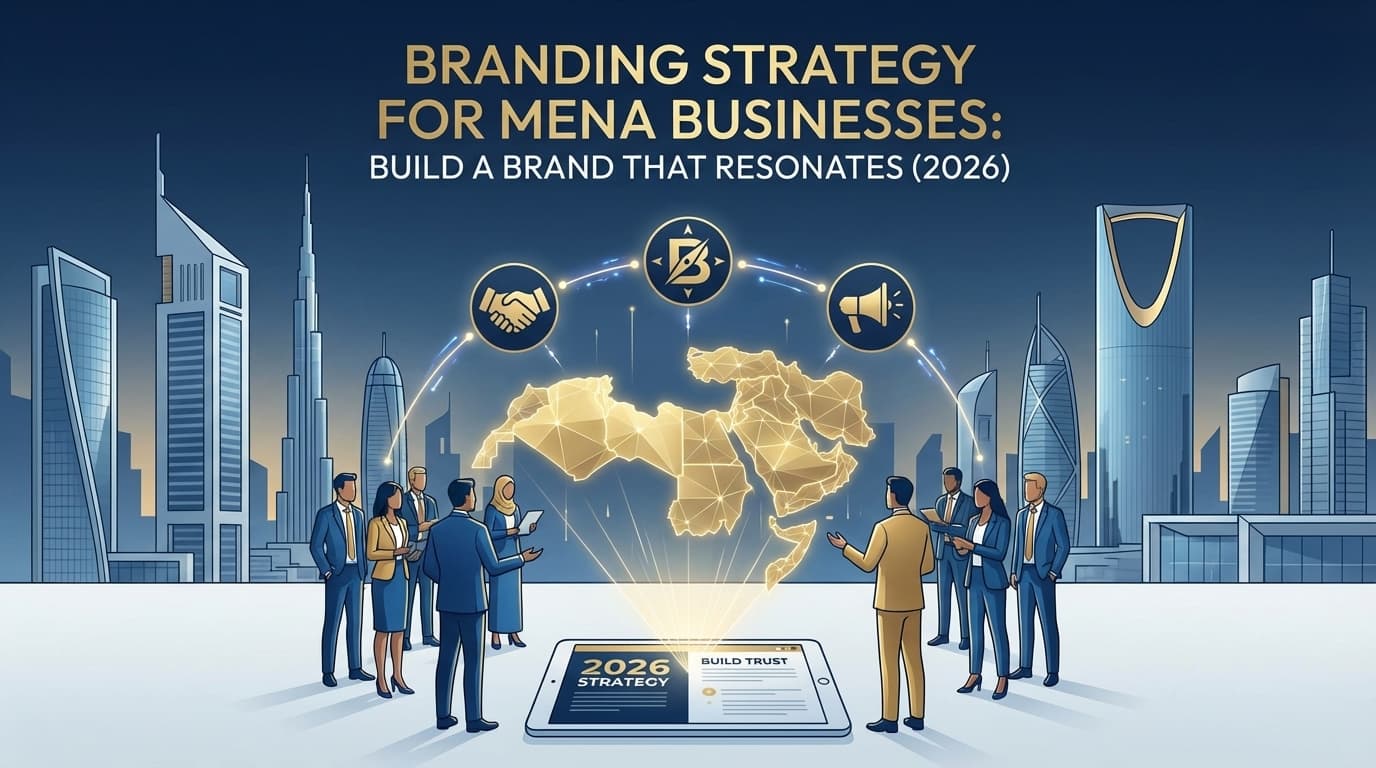
Branding in the MENA region requires navigating bilingual identity (Arabic and English), cultural sensitivity across diverse markets (Gulf, Levant, North Africa), and a competitive landscape where global brands and local challengers are both investing heavily. Effective MENA branding goes beyond logo design — it encompasses brand positioning, visual identity that works in both RTL and LTR contexts, tone of voice that adapts across Arabic dialects, and brand experience across digital and physical touchpoints. Companies with strong brands in MENA command 20-30% price premiums and see 2-3x higher customer loyalty compared to unbranded competitors.
Why Branding Matters More in MENA
MENA's business environment makes branding disproportionately important compared to other regions:
- 20-30% price premium commanded by strong brands in GCC markets (Kantar BrandZ MENA, 2025)
- 78% of GCC consumers say brand reputation is the #1 factor in purchase decisions (PwC Middle East, 2025)
- $4.2 billion invested in branding and advertising across GCC in 2025 (Arab Media Outlook, 2025)
- 92% of MENA consumers research brands online before making a purchase — your digital brand identity is your first impression (Google MENA, 2025)
Trust-Driven Markets
MENA's collectivist culture means brand trust is built through relationships, reputation, and word-of-mouth — not just advertising. A strong brand signal (professional visual identity, consistent messaging, social proof) shortens the trust-building process from months to days.
Global Competition
Saudi Vision 2030 and UAE's economic diversification have attracted global brands to MENA. Local businesses must differentiate through branding that resonates with regional identity while meeting international quality standards.
Digital-First Discovery
92% of MENA consumers research online before purchasing. Your brand identity — website, social media, Google Business Profile — forms their first impression. A weak or inconsistent brand costs you customers before you ever speak to them.
The MENA Brand Strategy Framework
Step 1: Brand Positioning
Your positioning defines where you sit in your customers' minds relative to competitors. In MENA, positioning must account for:
- Local vs. international perception — Some sectors (luxury, tech) favour international positioning. Others (F&B, services) benefit from local/regional positioning.
- Heritage vs. modernity — MENA consumers value both tradition and innovation. Position on a spectrum between "rooted in culture" and "forward-looking."
- Premium vs. value — GCC has both luxury-driven and price-sensitive segments. Choose one and commit.
Positioning statement template: For [target audience in MENA], [Brand] is the [category] that [unique value proposition] because [proof point]. Unlike [competitor/alternative], we [key differentiator].
Step 2: Bilingual Brand Identity
One of the most challenging aspects of MENA branding is creating a visual and verbal identity that works seamlessly in both Arabic and English:
Logo Design
- Create both Arabic and English versions of your logo — not a transliteration, but a designed Arabic logotype that carries the same visual weight
- Test legibility at small sizes in both scripts — Arabic requires slightly larger type to achieve the same readability as Latin script
- Consider a bilingual lockup — many successful MENA brands stack Arabic above English or place them side by side with a visual divider
- Use a symbol/icon that works without text — this provides flexibility across languages and contexts
Typography
- Pair Arabic and English typefaces that share visual characteristics (weight, proportion, mood). Example: Noto Sans Arabic + Inter, or Dubai Font + Montserrat.
- Arabic requires different sizing — set Arabic body text 1-2px larger than English for equal readability
- Never use auto-RTL tools for brand materials — always have a native Arabic designer review layouts
Colour Psychology in MENA
| Colour | MENA Association | Western Association | Use Carefully |
|---|---|---|---|
| Green | Islam, growth, prosperity | Nature, money | Avoid as primary for non-Islamic brands — can create unintended religious association |
| Gold | Luxury, prestige, heritage | Luxury, warmth | Universal positive — works exceptionally well in GCC |
| Blue | Trust, stability, technology | Trust, corporate | Safe choice for B2B and financial services |
| Purple | Creativity, modernity | Royalty, creativity | Growing in popularity with tech/innovation brands |
| Red | Energy, passion, urgency | Passion, danger | Effective for F&B and retail — less common in B2B |
| Black | Elegance, authority | Sophistication | Works well for luxury brands in GCC |
| White | Purity, simplicity | Clean, minimal | Essential for legibility in Arabic typography |
Step 3: Brand Voice and Tone
Your brand voice must adapt across Arabic and English while maintaining a consistent personality:
- Define voice attributes that transcend language — "confident but approachable", "expert but not condescending", "modern but respectful of tradition"
- Arabic tone considerations — Arabic communication tends to be more formal and respectful in B2B, more warm and personal in B2C. Avoid direct translation of English casualness.
- Dialect decisions — Gulf Arabic for KSA/UAE audience, Levantine for Lebanon/Jordan, MSA for pan-Arab formal communications
- Social media voice — Can be more casual and dialect-heavy than website or print materials
Step 4: Brand Experience Across Touchpoints
In MENA, brand consistency across touchpoints is critical because customers interact with your brand across more channels than in Western markets:
- Website — Bilingual with seamless Arabic/English switching. Not an afterthought translation.
- Social media — Adapted content per platform and language, not one-size-fits-all.
- WhatsApp — Brand voice maintained in conversational context. Templates and quick replies should feel on-brand.
- Physical presence — Signage, business cards, and meeting rooms that reflect brand identity. Physical presence carries extra weight in MENA's relationship-driven culture.
- Google Business Profile — Consistent naming, description, and imagery across all locations.
"The biggest branding mistake in MENA is treating Arabic as an afterthought. If your Arabic brand identity looks like a translation of your English one — with awkward typography, mismatched fonts, and mirrored layouts — you are signalling to Arabic-speaking customers that they are secondary. In a region where Arabic speakers are the majority market, that is a fatal positioning error."
Building Brand Equity in MENA
Brand Awareness Strategies
- Influencer partnerships — Collaborate with regional influencers who embody your brand values. See our social media marketing guide for influencer tiers and pricing.
- Content marketing — Publish thought leadership content in Arabic and English. Educational content builds brand authority faster than advertising.
- Event presence — GITEX, Seamless, LEAP, Web Summit Qatar. Physical events matter in MENA's relationship culture.
- PR and media — Arabic-language media coverage (Arabian Business Arabic, Argaam, Al Arabiya) builds trust with regional audiences.
Measuring Brand Health in MENA
| Metric | How to Measure | Target |
|---|---|---|
| Brand search volume | Google Trends + Search Console | 10% QoQ growth |
| Share of voice | Social listening (Brandwatch, Meltwater) | Higher than top 3 competitors |
| Brand mention sentiment | Arabic sentiment analysis tools | 80%+ positive |
| Direct traffic | Google Analytics 4 | 20%+ of total traffic |
| NPS (Net Promoter Score) | Post-purchase surveys | 50+ (excellent for MENA) |
Frequently Asked Questions
How much does branding cost in MENA?
Basic brand identity (logo, colours, fonts, basic guidelines) costs AED 15,000-50,000 ($4,000-$14,000) from a quality agency. Comprehensive branding (strategy, bilingual identity, guidelines, templates, website design) costs AED 50,000-200,000+ ($14,000-$55,000+). At Hovi Digital Lab, we deliver AI-accelerated branding packages that reduce timelines by 50% while maintaining design quality.
Should I have separate Arabic and English brand names?
Not necessarily. Many successful MENA brands use the same name across languages (Careem, Noon, Talabat). If your English name is difficult to pronounce or write in Arabic, consider a phonetic Arabic version rather than a translated name. Always test the Arabic pronunciation with native speakers — some English names have unintended meanings in Arabic.
How do I maintain brand consistency across GCC and Levant markets?
Create a comprehensive bilingual brand guidelines document that covers logo usage, typography, colour, voice, and photography for both Arabic and English contexts. Use a centralised digital asset management (DAM) system. Designate brand guardians in each market who can adapt the brand locally while maintaining core identity elements.
What makes a good brand in Saudi Arabia specifically?
Saudi consumers value brands that balance modernity with cultural respect. Your brand should feel innovative and forward-looking (aligned with Vision 2030's modernisation drive) while demonstrating understanding of Saudi values, traditions, and communication norms. Premium quality perception, Arabic-first communication, and strong social proof (reviews, awards, case studies) are essential for brand success in KSA.