AI sales enablement transforms B2B conversion rates by automating proposal generation, implementing predictive lead scoring, and deploying intelligent follow-up sequences. Companies using AI sales tools report 3-10x improvement in conversion rates, 90%+ reduction in proposal turnaround time, and 2-3x increase in revenue per sales rep.
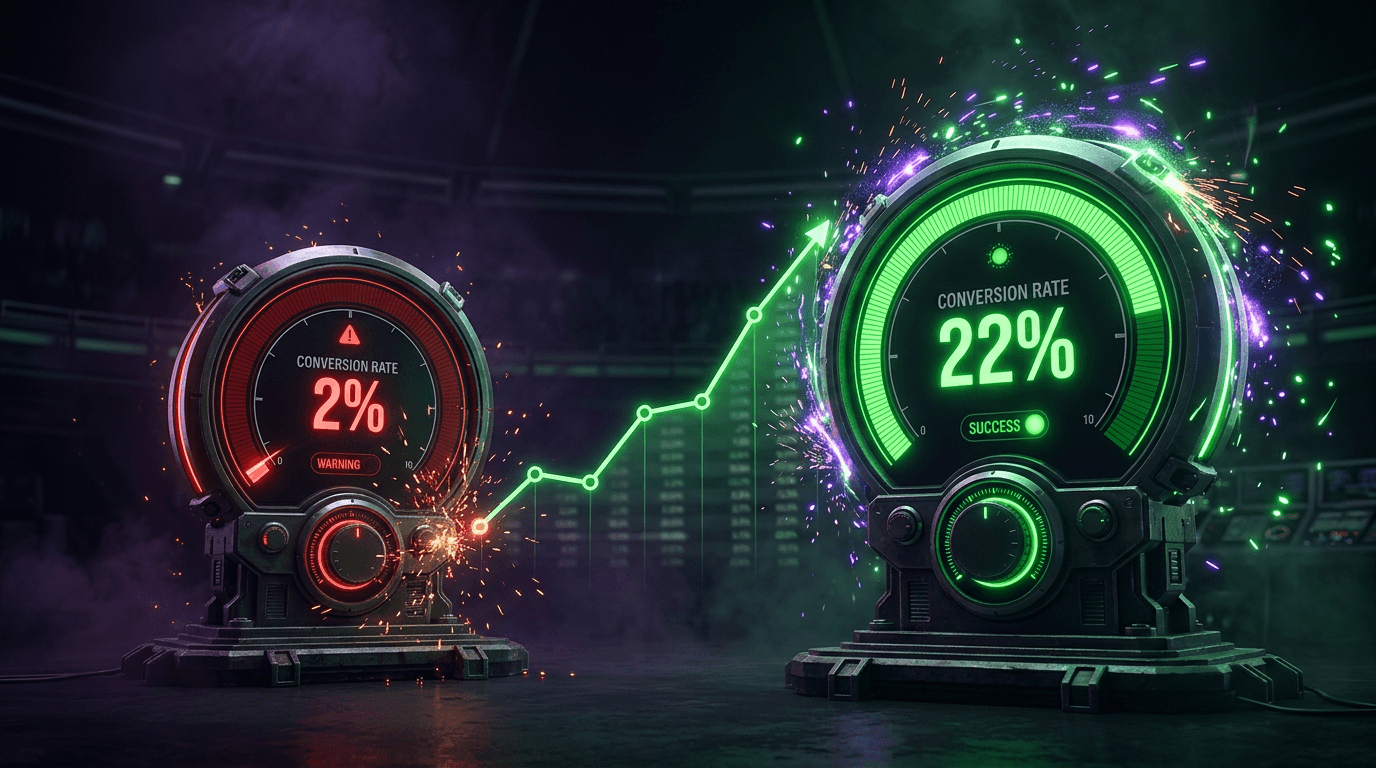
AI sales enablement is the use of artificial intelligence to arm sales teams with better leads, smarter insights, and automated workflows — so reps spend less time on admin and more time closing deals. In a real engagement, we helped MusicGrid go from a 2.17% conversion rate to 22.11%, cut their average deal close time to 24 days, and increase revenue per deal by 60%. Here's the exact playbook.
The Problem: Why Sales Teams Underperform (It's Not the Reps)
Before you blame your sales team, look at what you're asking them to do. A typical B2B rep in the MENA region spends their day like this:
- 30% on actual selling (calls, demos, proposals)
- 25% on CRM data entry and pipeline management
- 20% on lead research and qualification
- 15% on internal reporting and meetings
- 10% on chasing approvals and admin tasks
That means 70% of their time is spent on things that aren't selling. And then we wonder why conversion rates sit at 2–3%.
Here's the thing. Your reps aren't underperforming. Your system is. They're working with outdated lead lists, manual qualification processes, and CRMs that create work instead of eliminating it. AI sales enablement fixes the system — and the numbers follow.
The MusicGrid Story: 2.17% to 22.11%
When MusicGrid came to us, they had a solid product and a growing market. But their sales metrics told a different story:
- Conversion rate: 2.17%
- Average deal close time: 68 days
- Revenue per deal: stagnant for three quarters
- Lead quality: reps were spending 40% of their time on leads that would never convert
They didn't need more leads. They needed a smarter way to handle the ones they had.
What We Built
Our AI Sales Enablement engagement with MusicGrid had four components:
- AI-powered lead scoring — replaced their manual "gut feel" qualification with a model trained on their historical close data. The model scored incoming leads on 23 signals, from company size and industry to website behavior and email engagement.
- Automated pipeline management — built workflows that moved deals through stages automatically based on activity, sent reminders for stale deals, and flagged at-risk opportunities before reps noticed.
- Personalized outreach at scale — AI-generated email sequences and follow-up cadences tailored to each prospect's industry, pain points, and engagement history. Not mail merge — genuinely personalized messaging.
- Real-time deal intelligence — a dashboard showing each rep their hottest leads, recommended next actions, and competitive intel pulled from public sources.
The Results
| Metric | Before | After | Change |
|---|---|---|---|
| Conversion rate | 2.17% | 22.11% | +919% |
| Average deal close time | 68 days | 24 days | -65% |
| Revenue per deal | Baseline | +60% | +60% |
| Rep time on admin | ~70% | ~30% | -57% |
The conversion jump wasn't magic. It was math. When your reps only talk to qualified prospects, use personalized messaging, and follow up at the right time — more deals close. Simple as that.
The AI Sales Enablement Playbook: Step by Step
Want to replicate this? Here's the framework we use.
Phase 1: Sales Process Audit (Week 1–2)
We sit with your sales team — not management, the actual reps — and map their daily workflow. Where do they waste time? Which leads do they ignore? What makes them pick up the phone for one prospect and skip another?
This qualitative data is gold. It tells us what the CRM data can't: the informal rules and gut instincts that your best reps use, which we can then codify into AI models.
Phase 2: Lead Scoring Model (Week 2–4)
We analyze your historical deal data — wins, losses, deal size, close time, source — and build a predictive model. The model learns which characteristics predict a close and assigns a score to every lead in your pipeline.
But here's what separates good AI sales enablement from bad: we don't just score leads, we explain why. Each lead gets a score plus a plain-English reason: "High score — matches profile of your last 5 closed deals: mid-market SaaS, 50-200 employees, active on website in last 48 hours." Reps trust it because they can see the logic.
Phase 3: Pipeline Automation (Week 3–5)
This is where we connect the scoring to action. High-scoring leads get routed to your best reps instantly. Follow-up cadences trigger automatically. Stale deals get a nudge. Proposals that haven't been opened get a re-send with different subject lines.
We also build what we call "deal health monitoring" — an AI system that watches every deal in your pipeline and flags ones likely to slip. It catches warning signs like decreased email engagement, delayed responses, or stakeholders going quiet.
Phase 4: Content and Outreach (Week 4–6)
Your reps shouldn't be writing emails from scratch. We build AI-powered outreach templates that personalize based on the prospect's industry, company size, known pain points, and stage in the pipeline. The rep reviews and sends — but the heavy lifting is done.
This isn't the generic "Hi {FirstName}, I noticed your company {CompanyName}..." spam that everyone deletes. It's messaging informed by real data about what matters to this specific prospect. Our AI Content Engine powers much of this.
AI Sales Enablement Beyond Lead Scoring
Lead scoring gets all the attention, but the real ROI often comes from places people overlook:
- Meeting intelligence. AI that listens to sales calls, extracts key objections, and recommends responses. Your new reps learn in weeks what used to take years.
- Competitive battlecards. Automatically updated documents that show reps how to position against each competitor, based on real win/loss data.
- Proposal generation. AI that drafts proposals using your winning templates, customized to the prospect's requirements. What took 4 hours now takes 30 minutes.
- Forecast accuracy. Instead of reps sandbagging or over-promising, AI models predict close probability based on actual deal activity — giving leadership a forecast they can trust.
Common Mistakes in AI Sales Enablement
We've cleaned up enough failed implementations to know what goes wrong. Avoid these:
- Ignoring CRM data quality. Garbage in, garbage out. If your CRM is full of outdated contacts, missing fields, and duplicate records, no AI model will save you. Budget time for data cleanup before building anything.
- Not involving reps in the design. If your sales team sees AI as a surveillance tool or extra work, adoption will be zero. Involve them from day one. Let them shape the tool. Make it obvious that it helps them earn more commissions.
- Over-automating the human touch. Some moments require a personal call, a handwritten note, a dinner meeting. AI should tell you when to do those things, not replace them.
- Measuring the wrong things. Don't measure "number of AI-scored leads." Measure closed revenue, close time, and rep satisfaction. If those aren't moving, your AI isn't working.
Is Your Sales Team Ready for AI Enablement?
Quick diagnostic. Answer yes or no to each:
- Do you have at least 12 months of deal data in your CRM?
- Do your reps spend more than 50% of their time on non-selling activities?
- Is your current conversion rate below 10%?
- Do you have at least 3 sales reps?
- Are you generating more than 100 leads per month?
If you answered yes to three or more, you're a strong candidate. If you answered yes to all five, you're leaving serious money on the table every month.
AI Sales Enablement: Key Statistics
- MusicGrid achieved a 10x conversion improvement (2.17% to 22.11%) with Hovi AI sales enablement
- AI proposal generation reduces turnaround from 3+ days to under 2 hours
- 80% of B2B deals require 5+ touchpoints; AI ensures full follow-up (Salesforce, 2024)
- First vendor to respond has 35-50% higher win probability (Harvard Business Review, 2024)
Frequently Asked Questions
How much does AI sales enablement cost to implement?
A focused engagement — lead scoring, pipeline automation, and outreach optimization — typically runs $8,000–$15,000/month over a 3-month sprint. The ROI target is 3–5x within the first quarter. For MusicGrid, the revenue increase from the 60% per-deal lift paid for the engagement multiple times over in the first month alone.
Will AI replace our sales reps?
No. AI replaces the parts of their job they hate — data entry, research, report writing. Your best reps will become even better because they'll spend 70% of their time selling instead of 30%. We've never seen an AI sales enablement project result in headcount reduction. We've seen it result in quota increases, though.
How long until we see results from AI sales enablement?
Lead scoring improvements show up in 2–4 weeks as reps start prioritizing better leads. Pipeline automation impact is visible within 30 days. The full compound effect — higher conversion, shorter cycles, larger deals — typically materializes within 60–90 days. MusicGrid's 22% conversion rate was achieved within the first quarter.
Does this work for small sales teams (3-5 reps)?
It works especially well for small teams because each rep's time is more valuable. A 5-person team where each rep reclaims 15 hours per week is effectively getting 2 additional reps worth of selling time without hiring. The lead scoring model just needs enough historical data — typically 100+ closed deals — regardless of team size.
What CRM do we need for AI sales enablement?
We've implemented AI sales enablement on HubSpot, Salesforce, Pipedrive, and even spreadsheet-based systems (though we strongly recommend upgrading). The key requirement isn't the CRM itself — it's data quality and completeness. We'll audit your current setup and tell you exactly what needs to be fixed before we start building.
Your sales team is working harder than they should for the numbers they're getting. That's a system problem, and AI fixes systems. See how our AI Sales Enablement works, or get in touch for a free pipeline audit — we'll tell you exactly where the leaks are and what AI can plug.
Last updated: March 2026. Explore Hovi AI Sales Enablement, read the MusicGrid case study, or book a strategy session.