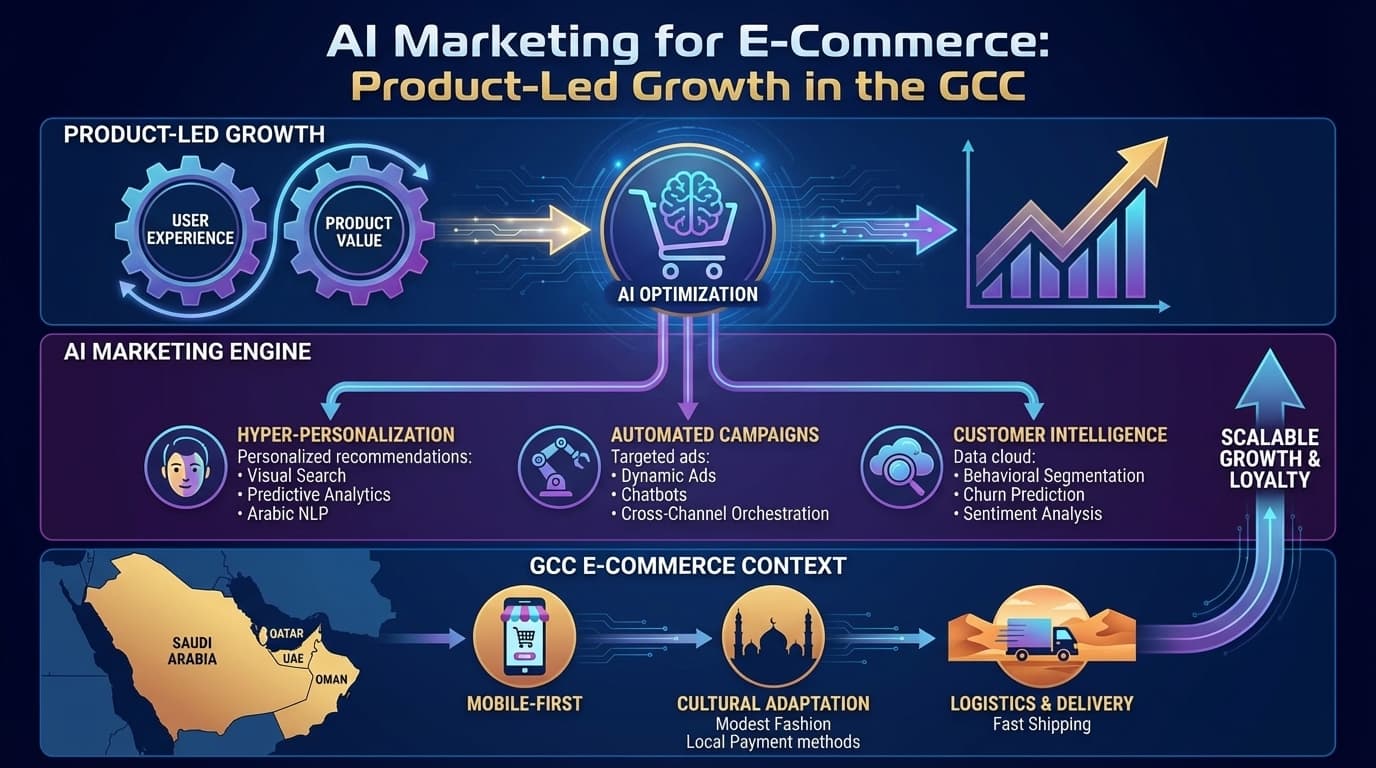
AI marketing for e-commerce uses predictive product recommendations, dynamic pricing engines, automated retargeting sequences, and AI-generated product content to increase conversion rates, average order value, and customer lifetime value for online retailers across the GCC. As of 2026, the MENA e-commerce market is projected to reach $57 billion, and AI-powered stores are capturing a disproportionate share of that growth.
Why E-Commerce Needs AI Marketing in 2026
The GCC e-commerce landscape has fundamentally shifted. According to Statista (2025), the MENA e-commerce market is projected to reach $57 billion by 2026, driven by near-universal smartphone penetration and a young, digitally native population. But market growth alone does not guarantee success for individual brands. Competition has intensified — both from regional players like Noon and international giants like Amazon.ae — and customer acquisition costs are rising 15-20% annually across most categories.
AI marketing addresses these pressures at every level. According to Shopify (2025), AI-powered product recommendations alone increase average order value by 26%. When you layer in dynamic pricing, automated retargeting, and AI-generated content, the cumulative effect is a compounding competitive advantage that manual marketing teams simply cannot match.
Consider the scale challenge: a mid-sized e-commerce store with 5,000 SKUs, running ads across Google, Meta, TikTok, and Snapchat, targeting customers in 6 GCC countries. Manually optimising creative, bids, budgets, and product feeds across that matrix is not just inefficient — it is impossible. AI makes it manageable.
6 AI Strategies for E-Commerce Growth
- Predictive Product Recommendations. AI analyses purchase history, browsing behaviour, and demographic data to recommend products each customer is most likely to buy. This is not the generic "customers also bought" widget. Modern AI recommendation engines personalise in real-time, adjusting suggestions as the customer navigates. Brands implementing advanced recommendation engines see 15-30% uplift in conversion rates and 20-35% increase in average order value.
- Dynamic Pricing Optimisation. AI pricing engines monitor competitor prices, inventory levels, demand signals, and margin targets to adjust prices in real-time. In the GCC, where flash sales and seasonal promotions drive significant revenue (Ramadan, Dubai Shopping Festival, White Friday), dynamic pricing ensures you are never overpriced during competitive moments or underpriced when demand is strong. The result is typically a 5-15% margin improvement without volume loss.
- AI-Powered Paid Advertising. AI manages ad creative generation, bid optimisation, budget allocation, and audience targeting across platforms simultaneously. According to Google (2024), mobile accounts for 72% of e-commerce traffic in the UAE — so AI creative must be optimised for mobile-first formats. Our clients typically see 30-50% improvement in ROAS within 90 days of AI ad management.
- Automated Retargeting Sequences. The average e-commerce cart abandonment rate in the GCC is 75%. AI retargeting does not just remind shoppers about abandoned carts — it personalises the message, timing, channel, and incentive based on the customer's purchase probability. High-probability buyers get a simple reminder; price-sensitive browsers get a targeted discount. This segmented approach recovers 15-25% more abandoned carts than blanket retargeting.
- AI Content Production at Scale. E-commerce demands enormous volumes of content: product descriptions, category page copy, ad creative, email campaigns, social posts, and seasonal landing pages. AI content engines produce this at 5-10x the speed of manual teams while maintaining brand voice and SEO optimisation. For a 5,000-SKU catalogue, AI can generate optimised descriptions for every product in days rather than months.
- Predictive Inventory and Demand Marketing. AI analyses sales velocity, seasonal patterns, and marketing campaign schedules to predict which products will see demand spikes. Marketing teams can then pre-position campaigns for high-stock items (push) and reduce spend on low-stock items (pull back) — preventing the dual problems of unsold inventory and out-of-stock disappointments during peak campaigns.
AI Tools for E-Commerce Marketing
Here is how AI-powered e-commerce marketing compares to traditional approaches across key functions:
| Function | Traditional Approach | AI-Powered Approach | Impact |
|---|---|---|---|
| Product Recommendations | Manual bestseller lists, basic "related products" | Real-time personalised recommendations based on behaviour + purchase history | +26% AOV (Shopify, 2025) |
| Pricing | Fixed prices, manual competitor checks weekly | Dynamic pricing adjusted hourly based on demand, competition, and inventory | +5-15% margin |
| Ad Management | Manual bid adjustments weekly, 5-10 creative variants | AI manages bids hourly, tests 100+ creative variants simultaneously | +30-50% ROAS |
| Retargeting | Same message to all cart abandoners | Personalised messaging, timing, and incentive based on purchase probability | +15-25% cart recovery |
| Content | Manual copywriting, 10-20 descriptions per day | AI-generated, SEO-optimised content at 200+ descriptions per day | 5-10x production speed |
| Email Marketing | Batch sends, basic segmentation | Predictive send times, dynamic content, individual-level personalisation | +20-40% email revenue |
Platform-Specific Tactics: Shopify, Noon, Amazon.ae
Shopify Stores in the GCC
Shopify powers a significant portion of D2C e-commerce in the UAE and Saudi Arabia. AI marketing for Shopify stores should focus on app-based recommendation engines (like Rebuy or LimeSpot), AI-generated product descriptions that incorporate Arabic and English keywords, and automated email flows through Klaviyo with AI-optimised send times. Shopify's native AI tools (Shopify Magic) handle basic content generation, but serious growth requires dedicated AI marketing infrastructure.
Selling on Noon
Noon is the GCC's homegrown marketplace, and AI marketing here centres on listing optimisation. AI tools can analyse top-performing listings in your category, identify keyword gaps, and generate optimised titles and descriptions that rank higher in Noon's search. Pricing strategy is critical on Noon — the platform favours competitively priced listings, so AI dynamic pricing that monitors competitor listings hourly gives a measurable ranking advantage.
Amazon.ae Marketplace
Amazon's A10 algorithm rewards conversion rate and sales velocity. AI marketing for Amazon.ae should focus on PPC bid management (AI handles the hourly bid adjustments that determine ad placement), A+ Content generation (AI creates enhanced brand content that improves conversion), and review velocity campaigns (AI-triggered post-purchase email sequences that increase review rates). According to eMarketer (2025), GCC digital ad spend is growing at 15%+ annually, with marketplace advertising commanding an increasing share.
Cross-Border E-Commerce in GCC with AI
According to Dubai CommerCity (2024), 60% of GCC e-commerce transactions are cross-border. This presents both an opportunity and a complexity challenge that AI is uniquely positioned to solve.
AI enables cross-border e-commerce marketing through:
- Multi-language content: AI generates and maintains product content in Arabic, English, and French simultaneously, ensuring consistency across markets while adapting tone and terminology for local audiences.
- Market-specific pricing: AI adjusts pricing by market based on local purchasing power, competitive landscape, and import duty considerations. A product priced at AED 199 in Dubai might be SAR 189 in Riyadh — AI calculates the optimal price point per market.
- Platform-specific ad creative: Different GCC markets have different platform preferences. Snapchat dominates in Saudi Arabia for younger demographics, while Instagram leads in UAE. AI generates platform-specific creative at scale rather than repurposing a single asset.
- Logistics-aware marketing: AI integrates with shipping data to suppress ads for products with long delivery times to specific markets, or promote express-delivery items during peak seasons.
Frequently Asked Questions
What is the average ROI of AI marketing for e-commerce in the GCC?
Based on our portfolio and industry benchmarks, AI marketing for GCC e-commerce brands delivers 250-600% ROI within the first 3-6 months. The wide range reflects differences in average order value, product category, and starting baseline. High-margin categories like beauty, fashion, and electronics tend to see faster and higher returns. The key driver is not any single AI tool but the compounding effect of AI across multiple touchpoints — from discovery to purchase to retention.
How does AI marketing work for small e-commerce stores with limited budgets?
AI marketing scales down effectively. For stores with under 1,000 SKUs and monthly ad budgets below $5,000, start with two high-impact applications: AI-powered ad management (which optimises every dollar of spend) and AI-generated product descriptions (which improve SEO and conversion without ongoing costs). These two interventions alone typically pay for themselves within 30-60 days. As revenue grows, layer in recommendation engines, dynamic pricing, and automated email sequences.
Which e-commerce platform works best with AI marketing in the GCC?
Shopify offers the deepest ecosystem of AI marketing integrations through its app store and native AI features. However, the platform matters less than the marketing infrastructure built on top of it. Whether you sell on Shopify, WooCommerce, Magento, or marketplace platforms like Noon and Amazon.ae, AI marketing tools connect through APIs and data feeds. The critical factor is data quality — whichever platform gives you the cleanest customer and product data will deliver the best AI marketing results.
Can AI handle Arabic-language e-commerce marketing effectively?
Yes, with caveats. Modern AI models handle Modern Standard Arabic well for product descriptions, ad copy, and email content. Dialectal Arabic (Gulf, Egyptian, Levantine) requires more careful prompting and human review. For GCC e-commerce, the best approach is AI-generated Arabic content with native-speaker review for tone and cultural appropriateness — especially for categories like beauty, fashion, and food where cultural nuance directly affects conversion. AI handles the volume; humans handle the nuance.
Ready to transform your e-commerce growth with AI? Book a strategy session with Hovi Digital Lab. We will audit your current store performance and build a custom AI marketing roadmap for your product catalogue and target markets. You can also explore our full AI marketing solutions to see how we help e-commerce brands across the GCC grow faster and more efficiently.