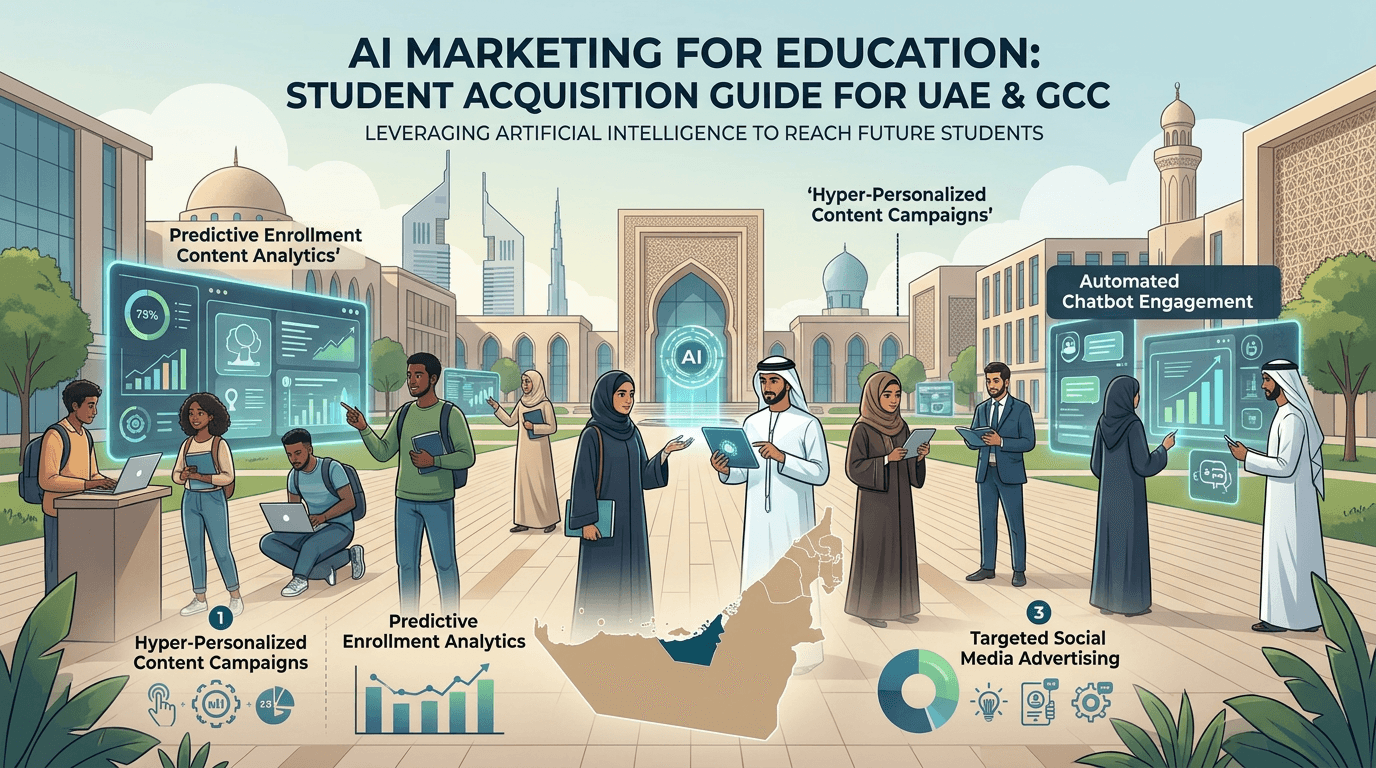
AI marketing for education combines predictive enrollment analytics, personalised student recruitment journeys, and AI-generated content at scale to help universities, schools, and training providers in the UAE and GCC fill seats more efficiently. As of 2026, the GCC education market is projected to reach $120 billion, and institutions using AI-powered acquisition outperform traditional recruitment by 3-5x on cost-per-enrollment metrics.
The State of Education Marketing in the GCC
The GCC education sector is undergoing rapid transformation. According to Alpen Capital (2024), the GCC education market is projected to reach $120 billion by 2027, driven by population growth, government investment in knowledge economies, and increasing demand for private education. Dubai alone hosts over 220 private schools serving 310,000+ students, according to KHDA (2025), with new institutions opening annually.
This growth creates intense competition for students. Every September, universities and private schools compete for the same pool of prospective students and their families — and the marketing landscape is shifting fast. According to Google (2025), education-related searches in the UAE grew 45% year-over-year, signalling that parents and students are increasingly making enrollment decisions based on digital research.
Yet most education institutions in the GCC still rely on traditional marketing: print brochures, school fairs, word-of-mouth referrals, and basic Facebook ads. The gap between how families research schools and how schools market themselves creates an opportunity for institutions willing to adopt AI-powered approaches.
5 AI-Powered Student Acquisition Strategies
- Predictive Enrollment Analytics. AI models analyse historical enrollment data, demographic trends, inquiry patterns, and external signals (like visa issuance data and corporate relocation announcements) to predict enrollment demand with 85-90% accuracy. This allows marketing teams to allocate budget before peak inquiry seasons, not react after them. For universities, predictive models can identify which programme combinations will see demand spikes, enabling targeted content creation months in advance.
- Personalised Student Journeys. A parent researching primary schools has fundamentally different needs than an 18-year-old exploring university options. AI creates segmented, personalised journeys that adapt content, messaging, and CTAs based on the prospect's stage and profile. An inquiry about a business programme triggers a sequence featuring career outcomes, alumni stories, and campus tour invitations — while an inquiry about engineering triggers lab facility showcases and research output. AI-powered websites make this personalisation possible at scale.
- AI-Generated Recruitment Content. Education marketing requires enormous content volumes: programme descriptions, campus life content, student testimonials, virtual tour scripts, parent guides, application walkthroughs, and seasonal campaign assets. AI content engines produce this at 5x the speed of manual teams while maintaining compliance with education authority guidelines. Critical for institutions marketing in both Arabic and English — AI handles bilingual content generation with human review for cultural accuracy.
- Smart Paid Advertising for Education. AI manages education ad campaigns across Google, Meta, TikTok, and Snapchat with platform-specific optimisation. For education, the key AI advantage is lookalike audience modelling: the system analyses your best-fit enrolled students and finds prospective families with similar profiles. Combined with dynamic creative that adapts to the viewer's likely interests (academics, sports, arts, STEM), AI ads consistently deliver 30-50% lower cost-per-inquiry than manually managed campaigns.
- Automated Inquiry Nurturing. Most education institutions respond to inquiries within 48-72 hours. By then, the prospective family has contacted 3-4 other schools. AI automation responds within minutes — sending personalised information packs, scheduling campus tour slots, and triggering SMS follow-ups that keep the institution top-of-mind throughout the decision cycle. For universities with 6-12 month decision timelines, AI drip campaigns maintain engagement through application deadlines, scholarship announcements, and programme updates.
AI vs Traditional Recruitment Marketing
| Capability | Traditional Approach | AI-Powered Approach | Impact |
|---|---|---|---|
| Demand Forecasting | Historical trends, gut feel | Predictive models with 85-90% accuracy | Budget allocated before demand peaks |
| Lead Response Time | 24-72 hours (business hours only) | Under 5 minutes, 24/7 | 3x higher conversion from inquiry to tour |
| Content Production | Manual: 2-3 programme pages per week | AI-assisted: 10-15 pages per week | 5x content velocity |
| Ad Targeting | Basic demographics and interests | Lookalike audiences based on enrolled student profiles | 30-50% lower cost per inquiry |
| Personalisation | One brochure for all prospects | Dynamic content adapted to prospect profile | 2x higher engagement rates |
| Nurturing | Manual email blasts, phone calls | Automated sequences triggered by behaviour | 40% more applications completed |
| Reporting | Monthly spreadsheets | Real-time dashboards with predictive insights | Faster optimisation decisions |
Compliance for Education Marketing in UAE
Education marketing in the UAE operates within specific regulatory frameworks that AI systems must respect:
- KHDA (Dubai): The Knowledge and Human Development Authority regulates how private schools in Dubai can market. Claims about rankings, academic outcomes, and inspection results must be accurate and current. AI content generation must be configured with compliance guardrails that prevent unverified claims.
- ADEK (Abu Dhabi): The Abu Dhabi Department of Education and Knowledge has its own marketing guidelines for private schools. AI campaigns targeting Abu Dhabi families must adhere to ADEK-specific requirements around fee disclosure and curriculum representation.
- CAA (Federal): The Commission for Academic Accreditation governs higher education marketing. Universities must ensure AI-generated content accurately represents accreditation status, programme availability, and tuition fees. QS Rankings (2025) notes that the UAE hosts 7 of the top 50 universities in the Arab world — but only institutions with verified rankings should reference them in marketing.
- Data Protection: The UAE's Federal Decree-Law on Personal Data Protection (2021) governs how student and parent data can be collected, stored, and used for marketing. AI systems must be configured for consent-based data collection, particularly when targeting minors' parents.
AI actually helps with compliance: content generation systems can be configured to flag or block non-compliant claims automatically, ensuring every ad, email, and landing page meets regulatory standards before publication.
How to Build an Education Marketing Funnel with AI
The education purchase journey is longer than most sectors — families typically research for 3-12 months before making enrollment decisions. Here is how AI supports each stage:
Awareness Stage (3-6 months before enrollment)
AI identifies families entering the research phase through search behaviour signals and life-stage targeting (new residents, growing families, career changers). Content at this stage is educational and comparative: "Top 10 Factors in Choosing a School in Dubai," "STEM vs. IB Curriculum: A Parent's Guide." AI generates this content optimised for both traditional search and AI citation engines. According to HolonIQ (2024), the global EdTech market is projected to reach $400 billion by 2028, reflecting the scale of digital transformation in education.
Consideration Stage (1-3 months before enrollment)
Prospective families are comparing 3-5 institutions. AI personalises the experience: dynamic website content that highlights the programmes they have browsed, retargeting ads featuring specific facilities or outcomes, and automated email sequences with virtual tour invitations. AI chatbots answer FAQs instantly — tuition, transport, uniforms, application deadlines — freeing admissions teams for high-value conversations.
Decision Stage (application and enrollment)
AI reduces friction in the application process: pre-populated forms based on inquiry data, automated document reminders, and personalised fee breakdowns. Post-application, AI manages the waiting period with engagement content that reinforces the choice — welcome videos, parent community introductions, and preparation guides.
Retention Stage (post-enrollment)
Student retention is cheaper than acquisition. AI monitors engagement signals (parent portal usage, event attendance, communication responsiveness) to flag at-risk families before they withdraw. Automated satisfaction surveys and personalised communication maintain the relationship throughout the academic year.
Frequently Asked Questions
How much does AI marketing cost for schools and universities in the UAE?
AI marketing investment for education institutions in the UAE typically ranges from AED 15,000-60,000 per month depending on institution size, number of programmes marketed, and geographic scope. For a single-campus school targeting one emirate, the lower end is realistic. Multi-campus universities marketing across GCC countries require the higher end. The critical metric is cost-per-enrolled-student, not total spend — AI typically reduces this by 40-60% compared to traditional recruitment marketing.
Can AI marketing help with international student recruitment?
Absolutely. International student recruitment is one of AI marketing's strongest applications for UAE universities. AI enables multi-language campaign management (targeting students in India, Pakistan, Egypt, and East Africa simultaneously), lookalike audience modelling based on existing international student profiles, and personalised content journeys by country of origin. The ability to run concurrent campaigns across 10+ markets with market-specific creative and messaging is something only AI can deliver efficiently.
How do we ensure AI-generated education content is accurate and compliant?
AI content generation for education should always include human review as a final quality gate, particularly for claims about academic outcomes, rankings, fees, and accreditation status. The best approach is to configure AI with compliance guardrails — a set of rules about what can and cannot be stated — and then have a compliance officer review AI-generated content before publication. This is faster than fully manual content creation while maintaining regulatory accuracy.
What results can we expect from AI marketing for education in the first semester?
Based on education sector benchmarks, institutions implementing AI marketing in the GCC typically see 30-50% more qualified inquiries within the first 90 days, 20-35% improvement in inquiry-to-application conversion rates, and 15-25% reduction in cost per enrolled student within the first academic cycle. The most immediate impact comes from AI-powered paid advertising and automated inquiry response — these two interventions alone can transform recruitment outcomes before SEO and content strategies fully mature.
Ready to transform your institution's student acquisition with AI? Book a strategy session with Hovi Digital Lab. We work with universities, private schools, and training providers across the UAE and GCC to build AI-powered enrollment growth engines. Explore our full AI marketing solutions to see how we can help your institution compete effectively in the region's most dynamic education market.