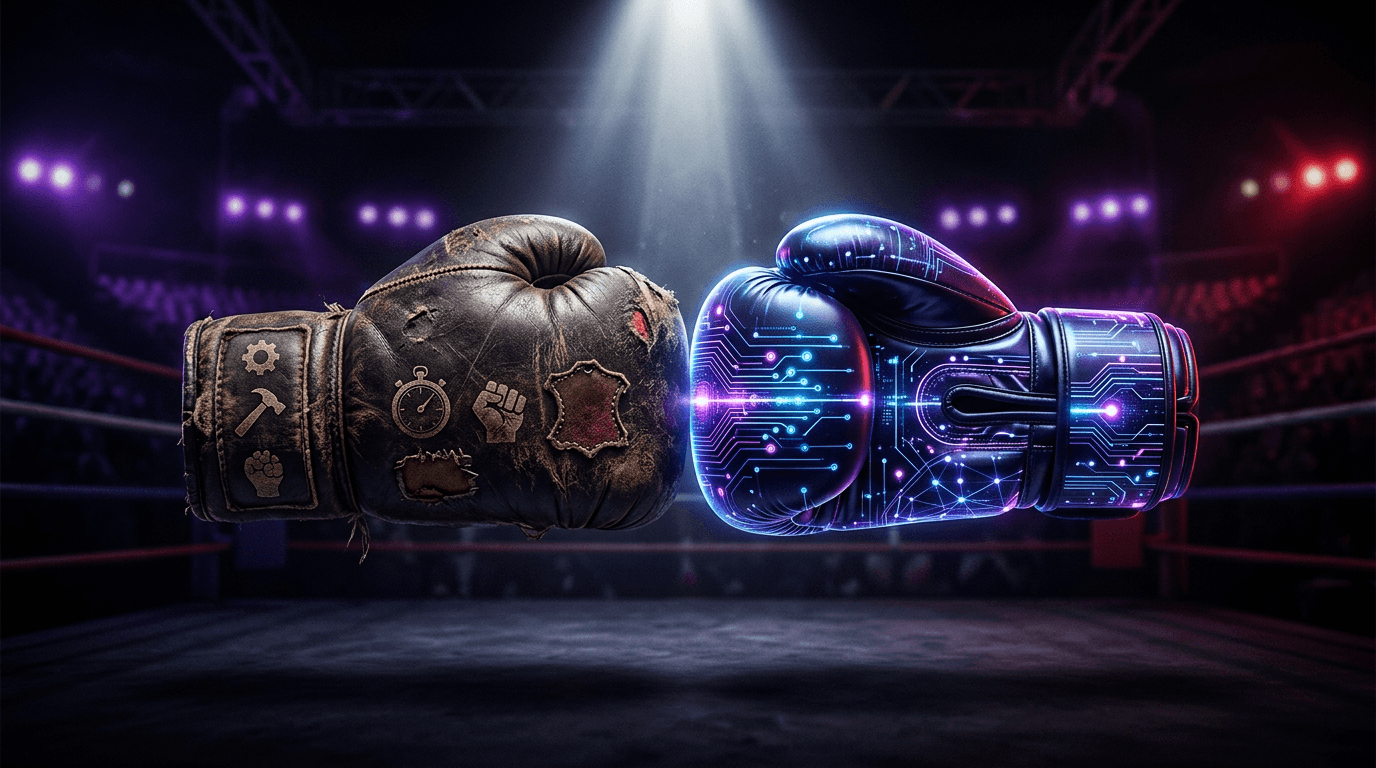
An AI marketing agency uses machine learning and automation as its core operating model — delivering campaigns 3x faster, testing 10-50x more creative variations, and reducing marketing overhead by 30-60% compared to traditional agencies that rely primarily on human labor and manual processes. The key difference is structural: AI agencies operate on systems, not headcount.
The debate between an AI agency vs traditional agency isn't really about technology — it's about operating models, speed, and how efficiently your marketing budget converts into revenue. An AI-native agency uses machine learning and automation as its core delivery mechanism, while a traditional agency relies primarily on human labor and established processes. Both can produce results, but the economics, timelines, and scalability differ dramatically. Here's the honest breakdown.
What Makes an AI Agency Different (Not Just Buzzwords)
Let's clear something up first. An AI agency isn't a traditional agency that bought a ChatGPT subscription. The difference goes deeper than tools — it's structural.
A traditional agency operates on a labor model. You need a campaign? They assign a team: account manager, strategist, copywriter, designer, media buyer, analyst. Each person does their piece. The quality depends on the talent of those individuals. Scaling means hiring more people. Speed is limited by the slowest person on the chain.
An AI agency operates on a systems model. The team is smaller but the output is amplified by technology at every step. AI handles data analysis, content variation, bid management, audience segmentation, reporting, and optimization. Humans focus on strategy, creative direction, and client relationships — the parts that actually require a human brain.
This isn't theoretical. It shows up in the numbers.
AI Agency vs Traditional Agency: The Full Comparison
Factor Traditional Agency AI-Native Agency Monthly retainer (mid-market) $8,000–$25,000 $5,000–$18,000 Campaign launch speed 3–6 weeks 1–2 weeks Content output per month 10–20 pieces 50–200+ pieces Ad creative variations tested 3–5 per campaign 20–50+ per campaign Optimization frequency Weekly manual review Real-time algorithmic + weekly strategic Personalization depth 3–5 audience segments Dynamic, per-user level Reporting Monthly PDF report Live dashboard + AI-generated insights Scale constraint Headcount-limited Compute-limited (virtually unlimited) Strategy quality Depends on assigned team Data-driven + senior human oversight
But raw comparisons don't tell the whole story. Let's dig into what actually matters for your business.
Speed: Where AI Agencies Win by a Mile
Time kills deals. In traditional agencies, getting a campaign from brief to live involves multiple rounds of creative review, internal approvals, media planning decks, and insertion orders. We've seen brands wait 8 weeks from brief to first ad impression.
When we onboarded NuYu MediSpa, their previous agency was producing 4 ad creatives per month and taking 3 weeks per campaign launch. Our approach: AI generates 30+ creative variations in the first week, the team reviews and selects the top performers, and campaigns go live within 10 days of kickoff. The result? A 2,415% increase in lead generation and a 133% surge in bookings.
Speed doesn't mean reckless. It means cutting out the 70% of traditional agency workflow that's coordination overhead, not creative thinking.
Cost: The Real Math (Not Just Retainer vs. Retainer)
A traditional agency charging $15,000/month might seem comparable to an AI agency at $12,000/month. But the comparison is misleading unless you look at cost per outcome.
Here's a real example. A luxury real estate client was paying their traditional agency $18,000/month and generating roughly 40 SQLs per month. That's $450 per SQL. When they moved to our AI-Driven Paid Ads model at a similar budget, SQL volume went to 320+ per month — about $56 per SQL. Same budget. 8x the output.
That's the Ohana Hills story. 800% more SQLs, 26% month-over-month organic traffic growth, and 220% ROI. Their media spend didn't increase dramatically. The efficiency of how it was deployed changed everything.
When evaluating cost, ask this question: what does each dollar of agency fee produce? Not what does the retainer cost — what does it generate? That reframes the entire conversation.
Quality: Where Traditional Agencies Still Have an Edge (Sometimes)
Let's be fair. There are things traditional agencies do well that AI hasn't fully replaced.
Big creative ideas. A Super Bowl-worthy campaign concept, a brand film that makes people cry, a viral activation that earns $10M in press coverage — these still come from brilliant human creatives. AI can generate variations of an idea, but the original spark? That's human.
Complex brand strategy. Repositioning a brand, entering a new market, managing a crisis — these require judgment, empathy, and experience that AI can inform but not replace.
Relationship-driven industries. In markets like the GCC where personal relationships and trust are currency, an agency with deep local connections and cultural intuition provides value that no algorithm can replicate.
That said, these scenarios represent maybe 10–15% of what most companies need from their agency. The other 85% — ongoing content production, ad management, optimization, reporting, lead nurturing — is where AI agencies deliver more for less. Every time.
Personalization: No Contest
This is where the gap is widest. A traditional agency might create 3 audience segments and tailor messaging for each. An AI agency creates dynamic content that adapts to individual user behavior, preferences, and purchase intent in real time.
When we deployed our AI Marketing Chatbot for a client, it handled personalized conversations with thousands of visitors simultaneously — qualifying leads, answering questions in Arabic and English, and routing hot prospects to sales. No traditional agency can staff a team to do that at 2 AM on a Friday.
And personalization compounds. The more data the AI processes, the better it gets at predicting what each customer wants. Traditional segmentation is static. AI personalization is a flywheel that accelerates over time.
The Hybrid Model: Best of Both Worlds
Here's the thing most articles on this topic won't tell you: you don't necessarily have to choose.
Some of our best engagements are hybrid. We handle the data-driven, AI-powered execution — paid ads, content production, workflow automation, analytics — while the client's traditional agency or in-house team handles brand creative, high-touch campaigns, and PR.
This works because the skill sets are complementary. The traditional agency provides the creative vision. We provide the machine that executes, tests, optimizes, and scales it. Neither side is stepping on the other's toes.
Consider the Bassam Fattouh engagement. The brand already had a strong visual identity and creative direction. What they needed was the data infrastructure and AI optimization to make their digital presence match their brand ambition. The result: 70% more orders, 168% traffic increase, and 810% growth in Instagram referral traffic.
When to Choose Which (An Honest Decision Framework)
Choose a traditional agency if:
You need a complete brand overhaul or brand-building from scratch
Your primary goal is creative campaign development for offline/experiential channels
You value a single point of contact who manages everything and you don't want visibility into the mechanics
Your budget is under $3,000/month (the AI advantage diminishes at very small scales)
Choose an AI agency if:
Your primary goal is measurable growth: leads, sales, traffic, conversions
You want data-driven decisions, not gut-feel recommendations
You need to scale content and campaigns faster than your team can produce manually
You want real-time optimization, not monthly reports with backward-looking data
You care about cost per outcome, not just cost per month
Choose a hybrid model if:
You have an established brand that needs both creative excellence and performance marketing
You want best-in-class for both brand and performance without one agency trying to be everything
You're a larger company with budget to support specialized partners
The Market is Moving — Are You?
Five years ago, the AI agency vs traditional agency debate was theoretical. Today it's settled by the data. Companies using AI-driven marketing approaches are seeing 3–8x better unit economics than those using traditional models alone. That's not a marginal improvement. That's a structural advantage.
The traditional agencies that survive will be the ones that integrate AI into their delivery model. The ones that don't will find themselves competing on relationships and reputation alone — which works until a client sees what AI-native execution actually produces.
We're not saying traditional agencies are bad. We're saying the model is evolving, and the companies that evolve with it will outperform those that don't. Just like companies that embraced digital outperformed those that clung to print. The question isn't if — it's when.
Key Statistics: AI vs Traditional Marketing
Frequently Asked Questions
Can an AI agency handle creative brand work?
Depends on what you mean by "creative." AI agencies excel at performance creative — ad variations, social content, email copy, landing pages. For brand-defining work like logo design, brand positioning, and campaign concepts, traditional creative agencies or specialized branding firms are still the better choice. The best AI agencies know this and are honest about it rather than trying to do everything.
Are AI agencies cheaper than traditional agencies?
On a retainer-to-retainer basis, AI agencies are typically 20–40% less expensive. But the real savings come from output efficiency. An AI agency at $12,000/month might produce 5x the volume and 3x the results of a traditional agency at $18,000/month. So yes, cheaper — but more importantly, more cost-effective per outcome. That's the metric that actually matters.
How do I evaluate an AI agency's claims?
Ask three questions: (1) Show me a case study with before-and-after metrics from a company similar to mine. (2) What specific AI tools and models do you use, and how do they integrate into your workflow? (3) Can I talk to a current client? Any agency that can't answer all three clearly is selling the sizzle without the steak. Also, be skeptical of agencies that claim everything is "proprietary AI" — most of the time, it's off-the-shelf tools with good implementation.
Will switching from a traditional to an AI agency disrupt our marketing?
There's always a transition period, typically 2–4 weeks. A good AI agency runs in parallel with your existing efforts during onboarding, then gradually takes over. At Hovi, we require access to historical data and existing accounts during the first week so there's no gap in performance. Most clients see improvement — not disruption — within the first month because the AI starts finding optimizations immediately.
Is the "AI agency" label just a marketing trend?
Some agencies have slapped "AI-powered" on their website without changing their actual delivery model. That's real, and you should watch out for it. But genuine AI-native agencies are structurally different — smaller teams, higher output, data-first processes, real-time optimization. The distinction matters. Ask to see the actual workflow, not just the pitch deck. If their process still involves a copywriter, designer, and media buyer doing everything manually with an AI spell-checker at the end, that's a traditional agency in AI clothing.
Ready to see what an AI-native agency can actually do for your numbers? Explore our HoviX solutions or get a free marketing audit. We'll show you exactly where AI can outperform your current setup — and we'll be honest about where it can't.
Last updated: March 2026. Ready to see what an AI-native agency can do? Explore AI marketing solutions or book a free strategy session with Hovi Digital Lab. See also: AI marketing for real estate, AI marketing for healthcare, AI marketing for e-commerce.