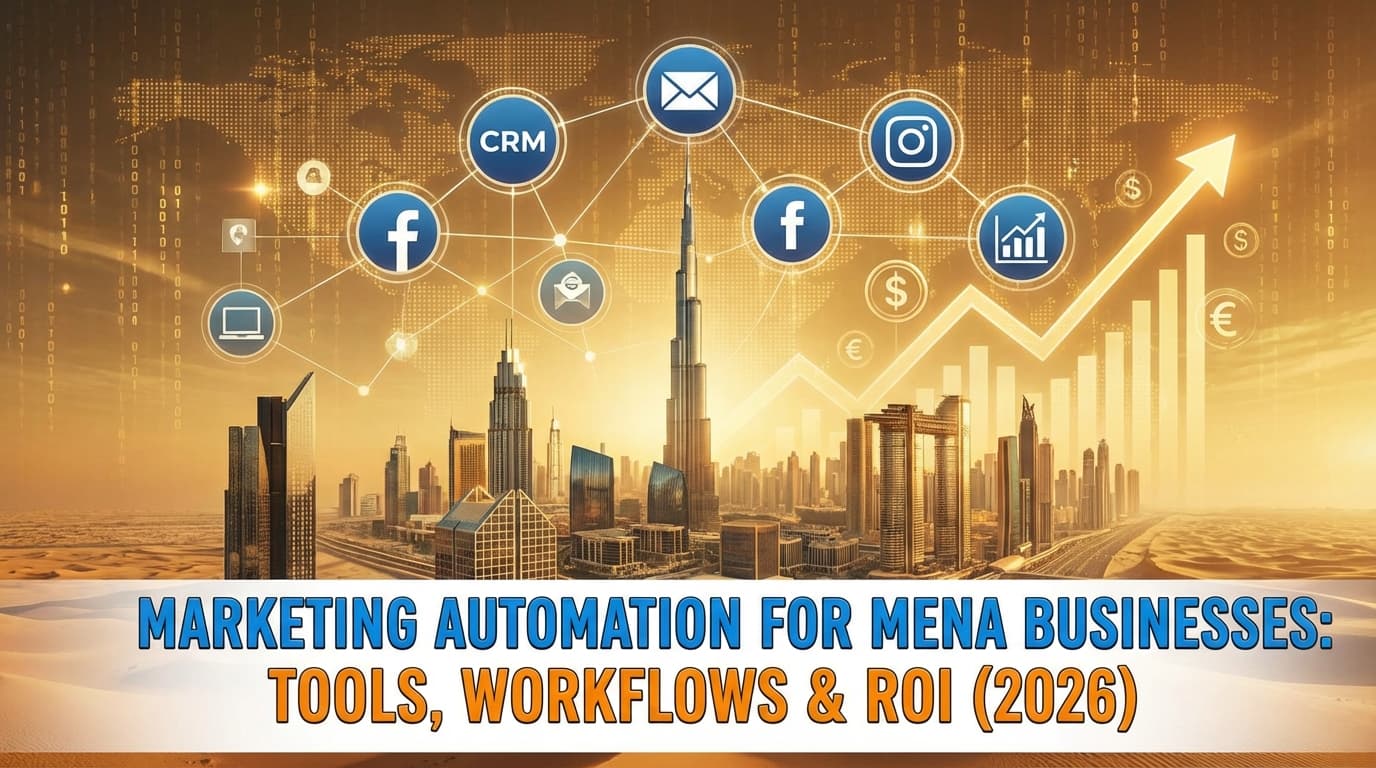
A marketing automation agency shouldn't be what you're searching for in 2026 -- you should be searching for a marketing automation system. Most CMOs manage 4-7 agency relationships, each with their own retainer, reporting cadence, and strategic blind spots. The result is fragmented execution, duplicated spend, and no single source of truth for marketing performance. AI-powered marketing systems replace this patchwork with integrated, always-on infrastructure that delivers better results at lower total cost.
The Agency Stack Problem: What You're Actually Paying For
Let's be honest about what most companies' marketing operations look like today. You've got a creative agency for brand work. A performance agency for paid ads. An SEO agency (or a freelancer) for organic search. A social media agency for content. A PR agency for media. Maybe a web development shop for your site. And a consulting firm that writes strategy decks nobody reads.
Each one sends a monthly report. Each report uses different KPIs, measured differently, in different dashboards. Your team spends 20+ hours a month just synthesizing these reports into something the CEO can understand.
Here's the part nobody talks about: the total cost.
| Agency Type | Typical Monthly Retainer (MENA) | What You Actually Get |
|---|---|---|
| Creative/Brand Agency | AED 25,000-80,000 | Brand guidelines, campaign concepts, quarterly creative assets |
| Performance/Paid Media | AED 15,000-50,000 + % of spend | Ad management across 2-3 platforms, weekly optimization, monthly reporting |
| SEO Agency | AED 8,000-25,000 | Monthly audits, keyword research, 4-8 blog posts, backlink outreach |
| Social Media Agency | AED 10,000-30,000 | Content calendar, 15-20 posts/month, community management |
| Web Development | AED 5,000-20,000 | Site maintenance, landing pages, minor updates |
| PR Agency | AED 15,000-40,000 | Media outreach, press releases, event coordination |
| Total | AED 78,000-245,000/month | Fragmented execution, no integration |
That's AED 936,000 to AED 2.9 million per year before ad spend. And what do you get? Six different strategies that don't talk to each other, six different reporting formats, and a marketing team that spends more time managing agencies than marketing.
The AI System Alternative: What a Marketing Automation Agency Should Look Like
The concept of a marketing automation agency is evolving. It's no longer about automating emails or scheduling social posts. It's about building an integrated marketing operating system where AI handles execution and optimization while humans handle strategy and creativity.
Here's what this looks like in practice, based on the work we've done for clients like Waseel, Ohana Hills, and MusicGrid:
One System, Not Seven Agencies
For Waseel -- a health tech company in Saudi Arabia -- we replaced their fragmented approach with an integrated marketing and sales system. The results: 500% ROI on marketing spend, 400% increase in website traffic, and #1 on Google for 900% more keywords. All from one integrated system, not six separate agency retainers.
The system we built included:
- Website: An AI-Powered Website built for performance and conversion, not just aesthetics
- Paid Ads: AI-Driven Paid Ads that optimize across Google, Meta, and LinkedIn 24/7
- Content: An AI Content Engine producing SEO articles, social content, and thought leadership at scale
- Sales: AI Sales Enablement with CRM integration, automated proposals, and pipeline analytics
- Operations: AI Workflow Revamps connecting every tool into a unified dashboard
Each component shares data with the others. The website knows which content is driving organic traffic. The ad system knows which landing pages convert best. The sales system knows which marketing channels produce the highest-value deals. Nothing operates in a silo.
The ROI Case: Real Numbers From Real Clients
Let's move past theory and look at what actually happens when companies make this switch. Here's a comparison table based on real client data:
| Metric | Before (Agency Stack) | After (AI System) | Change |
|---|---|---|---|
| Marketing ROI | ~100% (break even) | 500% | +400% (Waseel) |
| Sales Qualified Leads | Baseline | 8x Baseline | +800% (Ohana Hills) |
| Sales Conversion Rate | 2.17% | 22.11% | +920% (MusicGrid) |
| Deal Closure Time | 60-90 days | 24 days | -60% (MusicGrid) |
| Revenue Per Deal | Baseline | +60% | +60% (MusicGrid) |
| Lead Gen Volume | Baseline | 24.15x Baseline | +2,415% (NuYu MediSpa) |
| Organic Traffic | 2,000/month | 10,000/month | +400% (Waseel) |
These aren't hypothetical projections. These are measured outcomes from clients who transitioned from traditional marketing approaches to integrated AI systems.
The Transition Framework: How to Replace Your Agency Stack
You don't need to fire every agency on Monday. But you do need a clear transition plan. Here's the framework we recommend to CMOs making this shift:
Phase 1: Audit and Consolidate (Month 1-2)
Start by mapping every agency relationship, every tool subscription, and every workflow in your marketing operation. You'll likely discover:
- Overlapping work: Your SEO agency is producing blog content while your social media agency is writing posts on the same topics. Neither knows what the other is doing.
- Tool redundancy: You're paying for 3-4 analytics tools that each do 60% of what you need. None of them talks to the others.
- Data blind spots: No one can tell you the true cost of acquiring a customer from first touch to closed deal because the data lives in seven different systems.
This audit becomes the business case for consolidation. When the CEO sees that you're spending AED 2 million a year on a fragmented operation that can't answer basic questions about ROI, the case for change makes itself.
Phase 2: Build the Core System (Month 2-4)
Start with the highest-impact components. For most companies, that's:
- Website + SEO architecture: This is the foundation. Everything else drives traffic here. If the site doesn't convert, nothing else matters.
- Paid ads consolidation: Move all paid media to a single AI-managed system. Immediate savings from cross-platform budget optimization.
- CRM and sales integration: Connect your marketing to your sales pipeline. This is where most of the ROI lives -- not in generating more leads, but in converting the leads you already have.
Phase 3: Scale and Optimize (Month 4-6)
Once the core system is running:
- Add the content engine to replace your SEO and social agencies
- Deploy workflow automations to replace manual reporting and coordination
- Implement AI marketing chatbots for internal strategic intelligence
- Begin phasing out remaining agency relationships as the system absorbs their functions
Phase 4: Continuous Intelligence (Ongoing)
The system gets smarter over time. Every campaign generates data that improves the next one. Every deal that closes or doesn't teaches the AI about your market. This compounding intelligence is the real advantage -- something no agency relationship can match, because agencies serve dozens of clients and don't accumulate deep knowledge about any single one.
What You Keep Humans For
Let's be clear: AI systems don't replace your marketing team. They replace your marketing agencies. Your team becomes more strategic, not redundant.
Here's what stays human:
- Brand strategy and positioning: AI can execute, but the vision comes from humans who understand your market, your customers, and your competitive edge
- Creative direction: AI generates variations at scale, but the creative concept, the brand voice, and the emotional resonance come from human strategists
- Relationship building: In MENA especially, business runs on relationships. AI nurtures leads, but your team closes deals and builds partnerships
- Quality control: AI produces, humans approve. Every piece of content, every campaign, every automation gets human review before it goes live
For companies that want senior-level guidance through this transition, our Chief AI Officer service provides fractional AI leadership -- strategy sessions, implementation oversight, vendor evaluation, and team training without the full-time C-suite salary.
The Objections (And Honest Answers)
We hear the same concerns from every CMO considering this transition. Here's how we address them:
"We've invested years in our agency relationships." We get it. But sunk cost shouldn't drive future decisions. The question isn't "what have we spent?" -- it's "what's the best use of next year's budget?" If your current setup delivers fragmented results at high cost, loyalty to the structure doesn't serve your business.
"AI can't match the creative quality of our agency." You're right -- for hero campaigns and brand films, human creative directors are irreplaceable. But 80% of your marketing output isn't hero campaigns. It's the weekly social posts, the monthly blog articles, the email nurtures, the landing page variations, the ad creative tests. AI handles this 80% at higher volume and lower cost, freeing your budget and your best creative minds for the 20% that truly matters.
"Our industry is too specialized for AI." Fair concern, but incorrect. AI systems are trained on your specific data, your market, your audience. We've built systems for healthcare, real estate, luxury, and SaaS -- each highly specialized, each delivering measurable results.
"What about data security?" All data stays within your controlled environment. We integrate with your existing tools, implement proper access controls, and follow regional data protection requirements (including UAE data protection law and Saudi PDPL).
Frequently Asked Questions
How long does it take to fully transition from agencies to AI systems?
The core system (website, paid ads, CRM integration) can be operational within 2-3 months. Full transition including content, workflow automation, and sales enablement typically takes 4-6 months. We recommend a phased approach that runs parallel to existing agency contracts before fully transitioning, so there's no gap in marketing execution.
What's the typical cost savings compared to a traditional agency stack?
Our clients typically see 40-60% reduction in total marketing operational costs (agency fees + tool subscriptions + internal coordination time) while achieving significantly better results. The exact savings depend on your current agency spend, but the pattern is consistent: integrated AI systems deliver more output at lower cost because they eliminate the inefficiencies of fragmented execution.
Do we need to fire our entire marketing team?
No. The opposite, actually. Your marketing team becomes more valuable because they shift from managing agencies to driving strategy. They spend less time synthesizing reports and coordinating between vendors, and more time on the creative and strategic work that AI can't do. Some companies reallocate agency savings to hiring better in-house talent.
What happens if the AI system makes a mistake?
Every piece of content and every campaign goes through human approval before going live. AI generates and optimizes; your team reviews and approves. This is particularly important in regulated industries like healthcare and finance, where compliance review is non-negotiable. Think of AI as a highly productive junior team member who always needs sign-off, not an autonomous system making unsupervised decisions.
Can this work for smaller companies, or is it only for large enterprises?
AI marketing systems are actually more impactful for mid-market companies (AED 10M-100M revenue) because they level the playing field. A mid-market company with an AI system can produce marketing at the volume and quality of competitors 10x their size. Enterprise companies benefit too, but the competitive advantage is proportionally larger for companies that currently can't afford 6-7 agency relationships.
If you're a CMO tired of managing a fragmented agency stack that delivers inconsistent results, it's time to explore a different model. Schedule a consultation with our team to discuss what an integrated AI marketing system would look like for your specific situation. We'll map your current costs, identify the highest-impact opportunities, and show you exactly how the transition would work. Or browse our complete HoviX solutions to see every component of the system.